Chronic disease claims, misinformation, and what should change
The trilogy's closing volume applies Books One and Two to the questions that actually bring people to a supplement aisle: can anything here meaningfully affect a real chronic disease? Why does confident misinformation consistently beat careful evidence for attention? And when the claims meet real, documented cases — an FDA-banned stimulant, a red yeast rice product litigated for years, a longevity compound caught in a regulatory reversal — what does the evidence actually show? The book closes with an appendix proposing a specific, tiered framework for what U.S. supplement regulation should look like.
Books One and Two built two toolkits — how to evaluate a health claim, and how the regulatory and business system around supplements actually works. This book applies both to the hardest material in the investigation: real diagnoses, a real information ecosystem, and real documented cases.
Every chronic disease claim in this book is evaluated the same way: Claim → Biological rationale → Evidence → Clinical outcome → Risk → Bottom line — the same framework, run consistently, so a reader can apply it independently long after finishing the book.
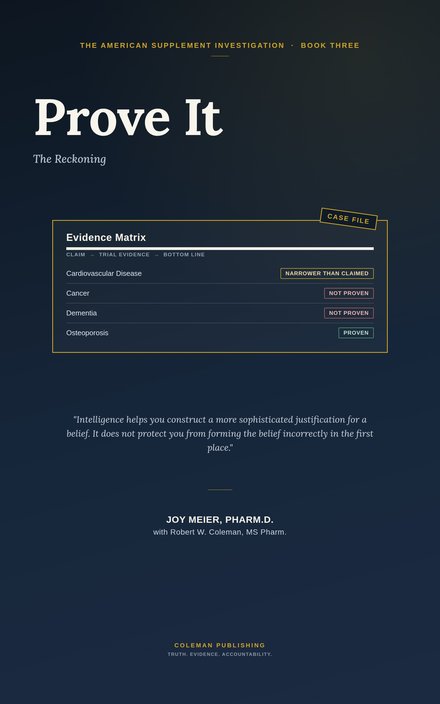
Fish oil shows a real, narrower cardiovascular benefit than marketed. Ginkgo biloba shows none at all for dementia, in the largest trial ever run on the question. Calcium and vitamin D are this book's deliberate exception — a real, replicated benefit for fracture risk, with a genuine cardiovascular caveat attached. Five conditions, one recurring shape: a plausible mechanism, a real trial, and a result narrower than the label implies.
A rigorous trial takes years and tens of millions of dollars. A confident video contradicting it takes an afternoon. This book explains why platforms structurally reward confident claims over accurate ones, why misinformation functions as a business model rather than a side effect for some publishers, and why intelligence — contrary to what most people assume — offers surprisingly little protection against believing a claim that isn't true.
"Intelligence helps you construct a more sophisticated justification for a belief. It does not reliably protect you from forming the belief incorrectly in the first place."Prove It
Four fully documented cases: the ephedra ban that followed a young athlete's death, a red yeast rice product litigated through the federal appeals courts, a persistent FDA enforcement pattern against tainted sexual-enhancement products, and a 2022–2025 regulatory reversal over a popular longevity compound — chosen deliberately to show that regulatory failure runs in more than one direction.
Chronic disease, vitamins, minerals, herbal remedies, and a rapid tour of ten marketed promises — weight loss to anti-aging.
Why science loses to content, the misinformation business, why smart people believe — and what Canada, Australia, the EU, and the UK do differently.
Four documented cases and a closing synthesis of the entire trilogy's findings, book by book.
A tiered evidence framework for U.S. supplement regulation, modeled on what's already working in Canada and Australia — not a demand to ban a category, and not the status quo. The appendix that closes this investigation.
Read the appendix