FOLLOW THE MONEY. FOLLOW THE SCIENCE. FOLLOW THE EVIDENCE.
A free, independent, evidence-based reference for dietary supplements.
COLEMAN PUBLISHING • PART OF BROKEN PROMISES HEALTHCARE
A free, independent, evidence-based reference resource for dietary supplements. Investigate ingredients, doses, clinical evidence, safety, drug interactions, regulatory status, and marketing claims — using peer-reviewed research and authoritative government sources, not marketing copy.
Search any real supplement by name and see its actual NIH-verified label — ingredients, doses, and claims.
See how America's best-selling supplements actually rate against the clinical trial evidence behind them.
Documented liver injury, drug interactions, and dose toxicity — where real, measurable harm has occurred.
Regulation, marketing, affiliate incentives, and the business models built to sell belief rather than results.
Want the whole story? Read the complete American Supplement Investigation trilogy — free →
This investigation isn't one book — it's a growing body of evidence on how the supplement industry works, what the science actually shows, and what's at risk when neither is disclosed.
Every GAO report, peer-reviewed trial, and federal source behind the numbers on this site — linked, verified, and organized by topic.
Browse the sources →The Evidence Pyramid, the difference between a mechanism and a result, and why "clinically studied" can mean almost anything.
Read the research guide →Why a supplement can reach a shelf with no premarket proof of safety or effectiveness — and what the label is and isn't required to say.
Read the research guide →Documented liver injury, drug interactions, and dose toxicity — the evidence on real, measurable supplement harm.
Read the research guide →Subscription models, affiliate commissions, multi-level marketing, and the vocabulary built to sell science it doesn't have.
Read the research guide →Canada's licensing model, Australia's tiered evidence system — the working alternatives to the U.S. approach.
Read the research guide →America's best-selling supplements, ranked, and rated against the actual clinical evidence behind each one.
Read the research guide →The most common questions people ask about safety, interactions, evidence, regulation, and dosing — answered and sourced.
Read the FAQ →Search across all three books, every research guide, the FAQ, and the full bibliography in one place.
Start searching →Look up any real supplement product's actual label — ingredients and claims — live from the NIH's own database.
Look up a product →A printable medication and supplement reconciliation worksheet — bring it to your next appointment.
Get the worksheet →Why do millions of Americans spend billions of dollars on supplements whose benefits may be uncertain, whose claims can exceed the evidence, and whose risks are often poorly understood? A three-part investigation follows the evidence from the medicine cabinet to a recommendation for what should change.
Evidence, anecdote, and the vitamin that reversed a generation of advice
A doctor recommended it. The biology made sense. Then the trial found the opposite. Built around the beta-carotene lung cancer trials of the 1990s, this volume teaches readers to tell a mechanism from a result, and a testimonial from proof — the toolkit for everything that follows.
What the law never required anyone to prove
A supplement can reach your shelf with no premarket safety or efficacy review. This volume follows the label, the marketplace, the documented harms, the dollar, and the vocabulary built to sell science it doesn't have — closing with a practical medication-and-supplement worksheet for your next appointment.
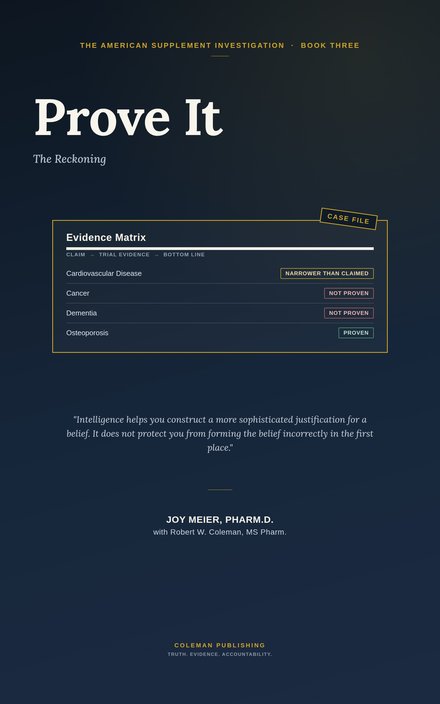
Chronic disease claims, misinformation, and what should change
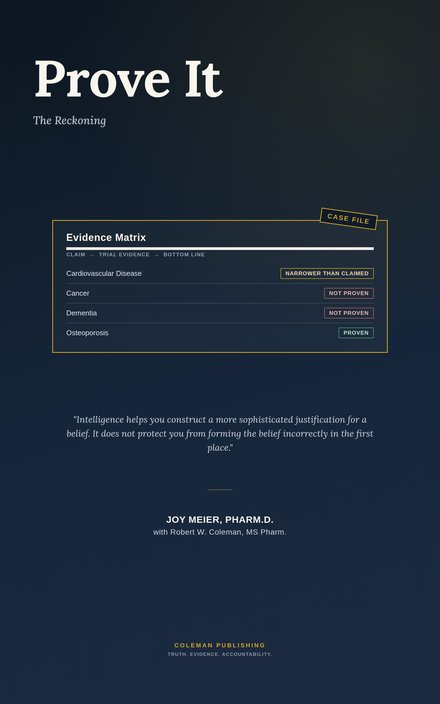
The trilogy's final volume applies Books One and Two to real chronic disease claims, the information ecosystem that spreads them, and a set of documented case files — closing with a specific, evidence-based recommendation for what U.S. supplement regulation should actually look like.
A tiered evidence framework modeled on Canada's and Australia's working supplement regulatory systems — not full drug-style approval, and not the status quo.
Read the appendix →Nearly three in four American adults take a dietary supplement. Most assume — reasonably, given how similar the packaging looks to regulated medicine — that some level of government testing stands behind the claim on the label. In most cases, none does.
This is not an argument that supplements are fraudulent. Some work, for some people, for some purposes, and the evidence for a few is genuinely strong. It is an argument that the confidence with which a product is chosen and the evidence that actually exists for it are, far too often, two very different things.
"I write as an investigator, not an advocate. The most dangerous claims are rarely the obviously false ones. They're the ones that are technically true, biologically plausible, and still misleading."
Drawing on Joy Meier's clinical pharmacy expertise and Robert Coleman's forty years in medicine — sixteen as Director of Clinical Pharmacy Services at the VA Palo Alto Health Care System — this investigation applies the same evidence-based standard as Broken Promises Healthcare to a $60 billion industry most Americans engage with every single day.
Every factual claim in this investigation is sourced — to peer-reviewed research, federal regulatory documents, or government data. Where a figure is an estimate or a range, we say so. If you believe a citation has been misrepresented, tell us — we want to know.
Forty years in medicine, sixteen of them as Director of Clinical Pharmacy Services at the VA Palo Alto Health Care System, where he ran medication safety programs for tens of thousands of veterans. His peer-reviewed research spans infectious disease, pharmacokinetics, anticoagulation therapy, and medical informatics. He writes as an investigator, not an advocate.
Questions about the research, the trilogy, or reform collaboration — reach out directly.
outreach@brokenpromiseshealthcare.org