Book One · The Promise and the Evidence

What the Label Doesn't Tell You

Evidence, anecdote, and the vitamin that reversed a generation of advice

In the early 1990s, doctors recommended a vitamin to smokers hoping to protect themselves from lung cancer. The biology made sense. The early data was encouraging. Then two of the largest trials ever run on the question found the opposite of what everyone expected. Built around that single, honestly-told story, this book teaches you to tell a mechanism from a result, and a testimonial from proof — the toolkit for reading any health claim you'll ever encounter, in this book or outside it.

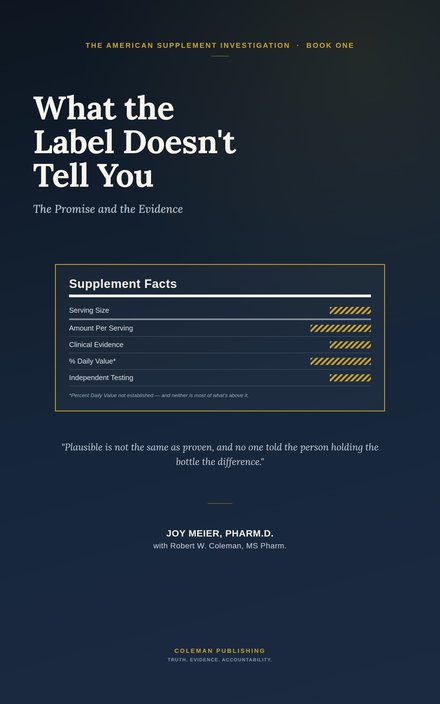
Cover of What the Label Doesn't Tell You
The Investigation

What This Book Is About

Open the medicine cabinet in a typical American bathroom, or the kitchen cupboard next to it, and you'll usually find more unprescribed products than prescribed ones — a multivitamin, a fish oil, something for sleep, something for stress. Fifteen bottles would not be unusual. None of them were prescribed. Most were bought on the strength of a promise rather than a diagnosis.

That cabinet, multiplied across roughly a hundred and thirty million American households, is the subject of this book — and the trilogy it opens.

4,000 → 80,000+Growth in U.S. supplement products since the law governing them passed in 1994
~75%Of American adults report taking a dietary supplement
$60B / $200BEstimated size of the U.S. domestic and global supplement markets

The Trust Gap

Most consumers assume, reasonably, that a product sitting on a shelf next to regulated medicine has cleared some kind of government safety and effectiveness check before it got there. Most of the other products on that shelf did. The supplement sitting between them, in most cases, did not — a legal classification quirk this book explains in full, and the companion volume, The Hollow Aisle, investigates at the level of the regulatory system itself.

This book's job is narrower and comes first: before examining what the law requires, you need the tools to evaluate a health claim yourself. Seven chapters build that toolkit — an Evidence Ladder running from testimonial to systematic review, an Evidence Pyramid ranking study designs by reliability, and a running case study that ties the whole book together.

The Beta-Carotene Story

Researchers in the 1980s had good reason to believe beta-carotene might protect smokers from lung cancer — the biochemistry was sound, and population data was encouraging. Two major randomized trials, together studying tens of thousands of smokers, tested the hypothesis directly.

The results ran in the opposite direction: an 18 percent increase in lung cancer diagnoses and an 8 percent increase in deaths among participants given beta-carotene in one trial, a pattern serious enough that both major trials stopped their beta-carotene arms early. A later review found an overall 20 percent increased risk, concentrated most heavily among smokers.

"The mechanism didn't predict the outcome. The trial produced a surprising outcome, and the mechanism had to be revised to explain it."What the Label Doesn't Tell You

Nobody in that story lied, cut corners, or acted in bad faith. That's precisely why it's this book's spine: the system worked exactly as it should have, once someone finally ran the test. What this book asks, chapter by chapter, is how much of what's on the shelf today is still waiting for that same test to be run at all.
Inside the Book

Seven Chapters, One Toolkit

Part I · The Promise

The Medicine Cabinet, Follow the Promise, The Power of Anecdote

Why consumers assume a product has already been proven, how marketing architecture builds belief, and why one compelling story can outweigh a thousand pages of evidence.

Part II · The Evidence

What Evidence Means, When Biology Sounds Like Proof, The Clinical Trial Test

The Evidence Pyramid, the beta-carotene trials in full, and how to read absolute versus relative risk before a marketing claim reads it for you.

Closing

When the Evidence Changes

Why a system capable of reversing a recommendation deserves more trust, not less — and the bridge into Book Two's regulatory investigation.

From the Book

Read the Preface

"This is not a book that will tell you which supplements to take. It's a book that will tell you how to ask the right question before you decide for yourself." — from the Preface, by Robert W. Coleman, MS Pharm.

Read the Preface →